
 Deutsch
 Nederlands
 Русский
 Türkçe
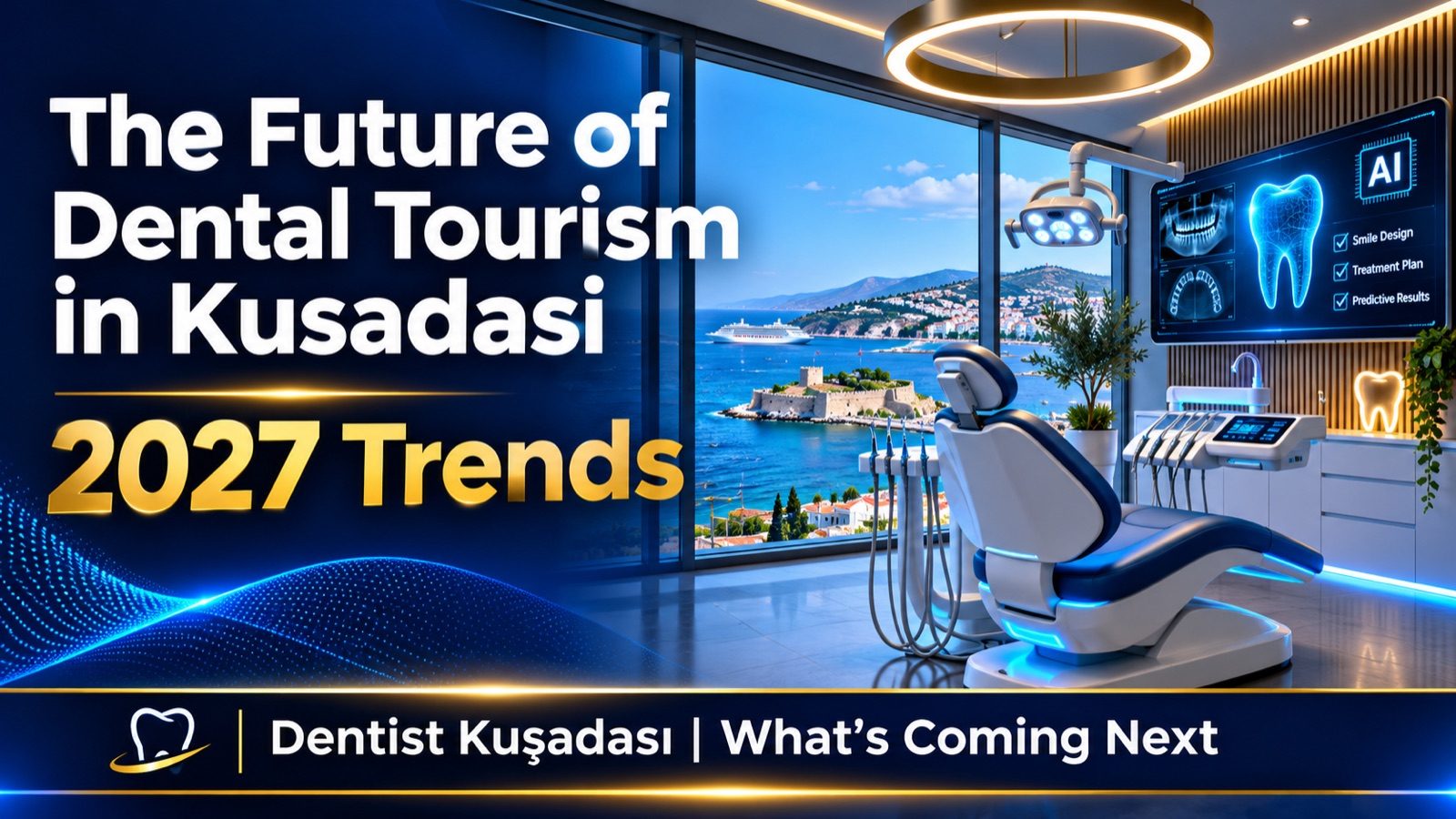
Dental tourism to Turkey has grown steadily for over two decades — but the industry is not standing still. New clinical technologies, shifting patient expectations, evolving regulatory frameworks and changing travel patterns are all shaping what dental tourism looks like heading into 2027. Here is what Dentist Kuşadası sees on the horizon, and what it means for patients considering treatment in Kusadasi in the coming years.
1. AI-Assisted Diagnosis and Treatment Planning
Artificial intelligence is moving from the fringes of dental practice to its mainstream. AI-powered diagnostic tools — capable of detecting early-stage caries, periapical pathology and bone loss in radiographic images with a level of consistency that reduces the risk of human error — are becoming commercially available to private practices globally.
In Turkey, adoption is accelerating. Leading health tourism clinics are integrating AI diagnostic software into their imaging workflows, allowing more consistent assessment and more defensible treatment planning documentation. For international patients, AI-assisted pre-assessment also opens the possibility of more detailed remote consultation before travel — a patient in Manchester could have their X-rays assessed by AI-augmented clinical review in Kusadasi before booking flights.
By 2027, AI-assisted treatment planning is expected to be standard practice at leading health tourism clinics rather than an innovation.
2. Full Digital Workflows — From Scan to Delivery
The shift from physical impressions to fully digital workflows is already well advanced at the best Turkish clinics. By 2027, the expectation is that the full chain — intraoral scan, digital design, CAD/CAM milling and virtual try-in — will be completed within a single clinical visit for most restorative procedures.
Same-day crown and veneer delivery, already possible with chairside milling units, is becoming more accessible as the cost of the technology decreases. For dental tourism patients — who need to compress a full treatment programme into a short visit — same-day digital workflows represent a significant practical advance, potentially reducing veneer and crown treatment from five to seven days to three to four.
3. Expanded AI-Powered Remote Consultations
The pre-travel consultation — currently conducted by WhatsApp, email and video call — is set to become significantly more sophisticated. AI-powered smile analysis tools allow patients to upload smartphone photographs and receive a preliminary digital smile design preview without leaving home.
Dentist Kuşadası is investing in remote consultation technology that allows prospective patients to receive a more detailed, visually rich preview of their potential treatment outcome before committing to travel. This reduces the uncertainty that still exists for some patients in the pre-booking phase and allows more informed consent before the first appointment.
💬 Ready to explore what your treatment could look like? Book a free consultation with Dentist Kuşadası today. Book My Free Consultation →
4. Growth of the Irish and European Markets
UK patients have historically dominated the English-speaking dental tourism market to Turkey. Over 2025–2026, Irish patient numbers have grown significantly — driven by some of Europe's highest private dental costs, direct seasonal flights from Dublin to Izmir and increasing awareness through social media and community word-of-mouth.
Alongside the Irish market, German-speaking patients from Germany, Austria and Switzerland represent a growing segment — Turkey's geographic proximity, established Turkish community networks and German-language capability in many Kusadasi clinics make it a natural destination for Central European patients.
By 2027, Kusadasi is expected to be firmly established as a pan-European dental tourism destination — not primarily a UK-facing one — with multilingual patient coordination becoming the norm at leading clinics.
5. Stricter Regulatory Standards for Health Tourism Clinics
The Turkish Ministry of Health has been progressively tightening the requirements for Health Tourism Authorisation Certificates since 2020. The trend toward stricter accreditation is expected to continue heading into 2027 — raising the minimum standard for clinics legally permitted to treat international patients and creating a clearer quality divide between accredited and unaccredited providers.
This is good news for patients. As minimum standards rise, the variance in quality between clinics decreases, and the risk of a poor outcome from a poorly regulated provider diminishes. Patients who verify Health Tourism Authorisation credentials before booking are protected by an increasingly robust standard.
Dentist Kuşadası holds full current authorisation and actively supports higher regulatory standards as a mechanism for differentiating quality providers from volume-focused competitors.
6. Personalisation and Patient-Specific Treatment Design
The era of generic veneer shapes and standard implant protocols is giving way to genuinely personalised treatment design. Advances in digital smile design software, facial scanning and patient-specific prosthetic fabrication allow treatment plans that are tailored not just to the teeth but to the full facial aesthetic — accounting for facial symmetry, skin tone, lip position, gum architecture and the patient's own aesthetic preferences in far more detail than was previously possible.
For dental tourism patients — who historically received more standardised treatment due to time constraints — digital personalisation tools are particularly significant. A treatment that is precisely designed in the days before travel can be executed with much greater aesthetic accuracy during the compressed clinic visit.
7. Integration with Travel and Wellness Tourism
Kusadasi's positioning as a destination — combining healthcare with genuine leisure appeal — is increasingly formalised. Hotel-clinic partnerships, dental tourism packages that include accommodation, transfers and guided excursions, and the growth of wellness tourism in the Aegean region are all contributing to a more integrated patient experience.
By 2027, the concept of a dental trip as a purely functional medical journey is expected to give way to a more holistic framing: a trip that delivers transformative dental results within a restorative, enjoyable travel experience. Kusadasi — with its beaches, history, cuisine and Aegean climate — is particularly well-positioned for this evolution.
✈ Want to experience the current standard at Dentist Kuşadası? Start with a free consultation and see what is possible today. Book My Free Consultation →
Frequently Asked Questions
Is dental tourism to Turkey still growing in 2026?
Yes. Turkey received a record number of health tourism patients in 2025 and the trend is continuing into 2026. Dental tourism represents a significant proportion of that total, with UK, Irish and German patients among the largest growth segments.
Will dental tourism prices in Turkey increase by 2027?
Prices in Turkey are influenced by the Turkish Lira exchange rate, inflation and the cost of imported materials. The structural cost advantage — lower labour costs, lower overheads — is expected to persist, though the specific price gap with UK and Irish markets may narrow modestly as Turkish costs rise and UK prices remain under pressure. The savings remain substantial by any measure.
Is Kusadasi investing in new dental technology?
Yes. Leading Kusadasi clinics — including Dentist Kuşadası — are investing in AI-assisted diagnostics, advanced CAD/CAM systems and remote consultation platforms. The technology available in Kusadasi in 2027 will be meaningfully ahead of what was available in 2023.
Will regulatory changes affect my treatment in Turkey?
Tighter regulation raises minimum standards — which benefits patients. Clinics that are already operating at a high standard, such as Dentist Kuşadası, are not negatively affected by increasing regulation. The main impact is on lower-quality providers who may struggle to meet rising standards.
What is the best time to book treatment at Dentist Kuşadası?
Booking four to six weeks in advance is recommended for most treatment programmes. For peak summer months (June–August), earlier booking is advisable. Spring (April–May) and early autumn (September–October) remain the most comfortable and cost-effective windows for dental travel.