
 Deutsch
 Nederlands
 Русский
 Türkçe
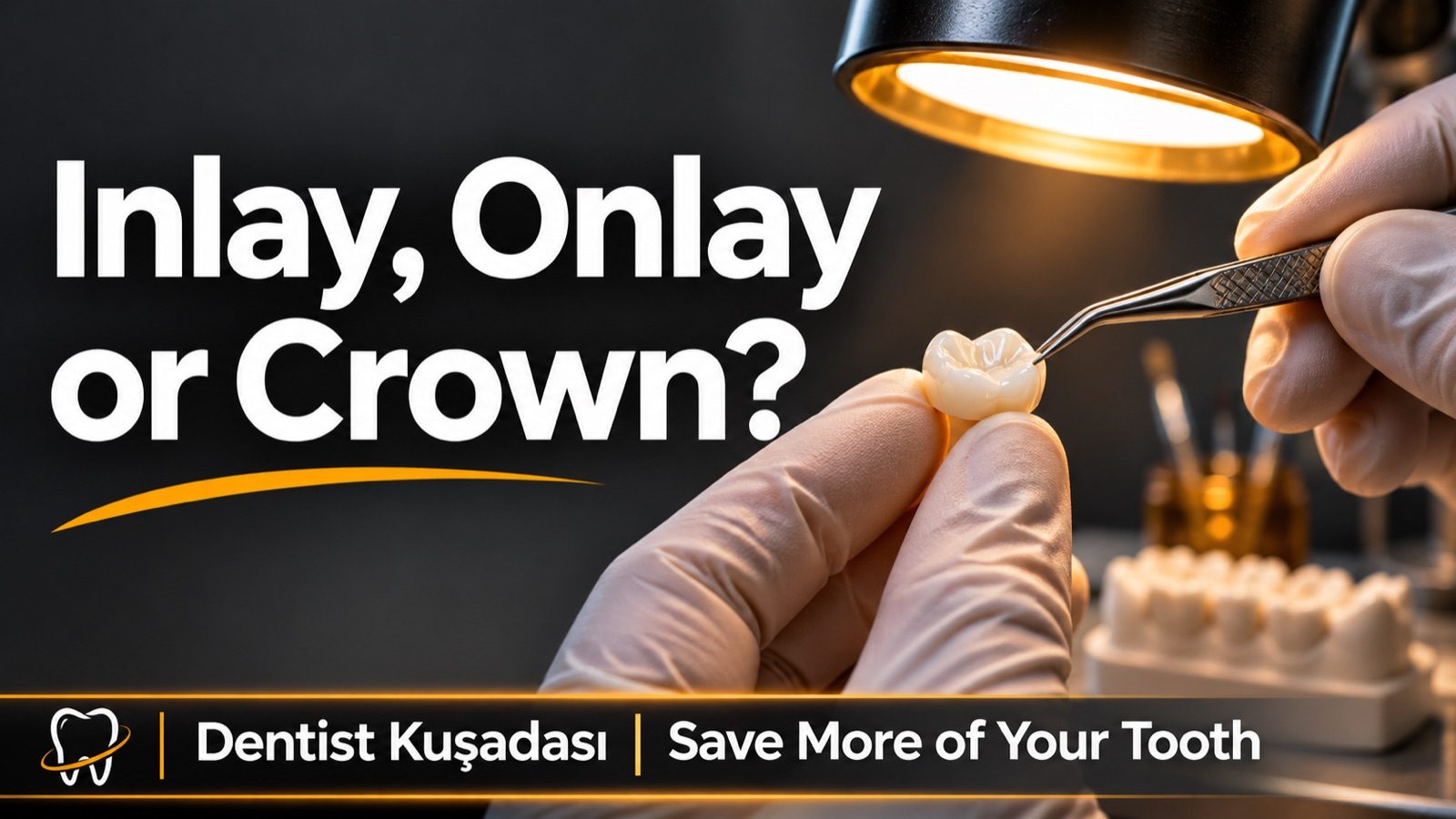
When a filling is too big but a crown feels like too much, there is something in between. Inlays, onlays and overlays are laboratory-made ceramic restorations that rebuild the damaged part of a tooth while leaving the healthy part untouched — and in Turkey they cost from £120, against £400 to £900 privately in the UK.
What Is the Difference Between an Inlay, an Onlay and an Overlay?
All three are made outside the mouth and bonded in. What separates them is how much of the biting surface they replace. An inlay sits inside the cusps, an onlay covers one or more cusps, and an overlay covers all of them — at which point it is close to a crown but still preserves the tooth's outer walls.
- Inlay: fills the hollow between the cusps. Replaces a large filling without touching the tooth's outer structure.
- Onlay: covers one or more weakened cusps. Used when a cusp is cracked or undermined by old decay.
- Overlay: covers the entire biting surface. Often used after root canal treatment or in heavy grinders.
- Crown: covers everything including the walls. The tooth is reduced all round.
The clinical principle is simple: remove as little sound tooth as the situation allows. A crown placed where an onlay would have worked removes healthy structure that never grows back.
When Is an Onlay Better Than a Crown?
An onlay is usually preferable when the outer walls of the tooth are still sound and the damage is confined to the biting surface. A crown becomes the better option when the walls themselves are cracked, undermined or too thin to support a bonded restoration.
| Situation | Usual choice | Why |
|---|---|---|
| Large old amalgam, walls intact | Inlay or onlay | Preserves the outer tooth |
| One cracked cusp | Onlay | Covers and protects only the weak part |
| Root-treated molar, walls sound | Overlay | Protects against fracture, less reduction than a crown |
| Walls thin or cracked all round | Crown | Only full coverage holds it together |
| Small to moderate cavity | Direct composite filling | Lab restoration is unnecessary |
💬 Been told you need crowns on several back teeth? Send your X-rays and we will tell you which of them could be restored with something smaller — free, and with the reasoning written out. Get My Free Assessment
How Much Do Inlays and Onlays Cost in Turkey?
Ceramic inlays in Turkey cost from £120 and onlays from £140, compared with £400 to £900 in UK private practice. The gap is wider than for simple fillings because most of the cost is laboratory time and material.
| Restoration | Turkey | UK (private) |
|---|---|---|
| Ceramic inlay | £120 – £200 | £400 – £700 |
| Ceramic onlay | £140 – £230 | £500 – £800 |
| Overlay (full biting surface) | £160 – £260 | £600 – £900 |
| Zirconium crown (for comparison) | From £130 | From £650 |
Figures are 2026 estimates. Note that a crown is not always cheaper than an onlay — so the choice should be clinical, not financial.
How Long Do They Last?
Bonded ceramic inlays and onlays perform well over the long term in clinical studies, with survival broadly comparable to crowns on similar teeth. The most common reasons for failure are new decay at the margin and fracture in patients who grind heavily.
Longevity depends on the bond, and the bond depends on isolation during placement. A restoration cemented on a tooth contaminated with saliva will not last, however good the ceramic. It is a technique-sensitive procedure, which is part of why some practices default to crowns instead.
What Are They Made From?
Most are lithium disilicate ceramic — the same material family used for laminate veneers — chosen for its bond strength and appearance. Zirconia is used where load is very high, and composite versions exist as a lower-cost option with a shorter expected life.
Material choice interacts with the rest of your mouth. If you already have zirconium crowns elsewhere, matching the shade and the wear characteristics matters. Details of the restorations we place are on our inlay, onlay and overlay page.
How Many Visits Does It Take?
Two appointments in most cases: the tooth is prepared and digitally scanned at the first, and the finished restoration is bonded at the second, usually two to three days later while the on-site laboratory produces it. Allow four to five days in Kuşadası for a small number of teeth.
"On-site" is doing real work in that sentence. The digital scan goes to a technician in the same building rather than to an external lab, which is why an adjustment takes hours instead of a return trip — and why the technician can look at your actual teeth when matching the ceramic, not just a model of them. For straightforward single units, chairside milling can shorten this further.
Where the damage turns out to be smaller than expected once the old filling is removed, a direct composite filling may be the better answer and the plan changes on the day. A clinic that will revise downwards after opening the tooth is behaving correctly.
✈ Want a plan that removes as little tooth as possible? Book your free online assessment and we will map each tooth to the smallest restoration that will hold. Get My Free Quote
Frequently Asked Questions
What is the difference between an inlay and an onlay?
An inlay sits inside the cusps of the tooth and replaces the hollow biting area, while an onlay extends over one or more cusps to protect them. An overlay covers the entire biting surface. All three preserve more natural tooth than a crown, which covers the walls as well.
How much do inlays and onlays cost in Turkey in 2026?
Ceramic inlays in Turkey cost £120 to £200, onlays £140 to £230, and overlays £160 to £260. Equivalent UK private pricing ranges from £400 to £900 depending on the restoration and the material used.
Is an onlay better than a crown?
It is better when the outer walls of the tooth are still sound, because it preserves structure that a crown would remove. It is not better when the walls are cracked, undermined or too thin to support a bonded restoration — in those cases full coverage is what holds the tooth together.
How long do ceramic inlays and onlays last?
Bonded ceramic restorations perform well over the long term, with survival broadly comparable to crowns on similar teeth in clinical studies. Longevity varies between individuals and depends on the quality of the bond, oral hygiene and whether you grind your teeth.
How many visits do I need for an inlay or onlay?
Two appointments in most cases — preparation and digital scanning at the first, bonding of the finished restoration at the second, typically two to three days later. Allow four to five days in Kuşadası for a small number of teeth.